

What you’re about to read is the second essay of a six-part exploration of how scarcity lives in the body, drives our obsession, shapes our relationship to ourselves, others and money, and keeps us from what we truly need—and how turning toward it can begin to teach us abundance. In this essay, I look at how emotional scarcity impacts our material scarcity.
I decided to talk about this specific topic because for many (perhaps ALL) of us, the subject of money invokes dread, fear, tension and a lot of SHAME, as if we did this to ourselves.
The problem with shame is that, it often drives more avoidance, because shame tells us that there is something inherently wrong with us. By talking about this openly, by speaking from the ‘I’, I want to show you that:
You’re not alone
That means this is not a personal fault but structural patterns that were imposed on us (maybe before we were born)
And it is our responsibility to change those (even if it’s just a tiny bit!)
The first step for me is to write like no one will read and publish when it feels really scary. I want to SAY. IT. ALL. The truth is: I am so done with being scared and ashamed.
Ok, deep breaths !
There are days when I catch myself reacting to something small—a delayed text, a slightly distant tone, a door closed one second too long—and suddenly my entire chest feels I am 8 years old, again. It’s startling how quickly the body can time-travel. That is the way I teach trauma in Liberation Practice Field: trauma is time-travel.
It has the capacity to take us right back where it all started. If there is anything that remains with you from this piece (thank you for reading !), I hope it’s this:
the body is so kind.
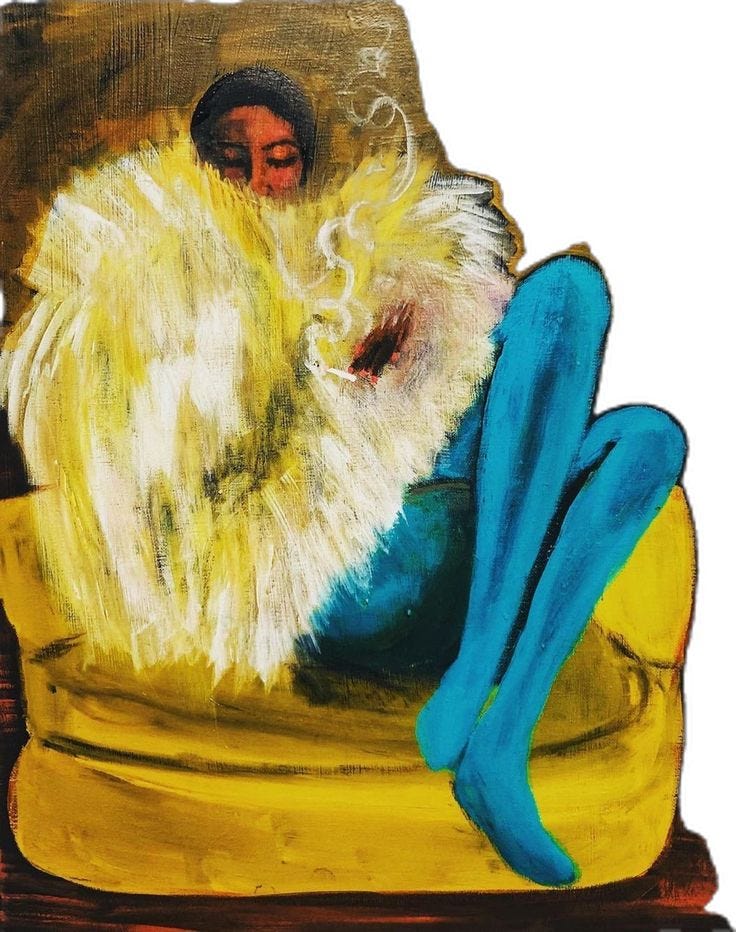
The body pulls us back, like a child taking us by the hand, urging us to “Look! There’s something really interesting happening right now!”
Today I want you to look at emotional scarcity and the impacts it has on your financial life, no matter what it looks like.
Emotional scarcity doesn’t always enter the body with drama. Sometimes it seeps in quietly, through the moments when no one noticed the tremble in your voice, the nights you swore to yourself you’d refuse to receive because nothing ever stays, the times you learned to stop asking because asking led nowhere. It accumulates in the nervous system like sediment—fine, barely visible grains that eventually become a landscape. And in that landscape, desire becomes dangerous. Longing becomes shameful. Needing becomes humiliating.
I write that because this is me, too.
My whole childhood, I felt like (because I was told) that I was a financial weight. Another mouth to feed.
I was convinced that money was the reason why my mother and I could not stand each other. That if her financial situation were better, we would be better. Now I feel sad writing this. The truth is, money was always there — loud in the background, yet somehow the one thing we were never allowed to name. Like a ghost. When I would leave the lights on for too long, my mother would remind me that ‘on n’est pas Crésus! — we are not King Croesus’, which is the equivalent of ‘we’re not made of money’.
Looking back, I can say that the way we dealt (or didn’t) with money was the exact same way we dealt with BIG emotions. The ones that make you feel and look a little too… human. Like sadness, fear, shame, but also excitement and big joy.
What I find fascinating about money — whether we hoard it, are stolen from it or somewhere in between— is that it never lives in our wallets only. It lives in the stories we tell ourselves and each other about it. It lives in the way we show up for one another and ourselves. It carries stories of fear, worth, scarcity, and survival, often long before we even realize it. And that is true for all of us.
So, I want you to ask yourself:
What are the stories I was told about money, growing up? What is my very first memory about money? What did my caregivers say about money, if anything? How is this impacting my relationship to money now?
A few years back, during therapy, I had the biggest breakthrough of my life. It came through as the biggest pain, as it often does.
I realised that money had nothing to do with my relationship with my mother. Yes, poverty made things really complicated for us and I am certain that poverty made my mother emotionally unavailable. My first memory about money is witnessing my mother, her face in both her hands, crying over a bill. I was as tall as the living room table, and I remember leaning in to see what was making her cry. She snatched the bill away from my eyes immediately. I absorbed the unspoken message: bills are dangerous — never look. As an adult, I’ve spent years oscillating between two extremes: ripping open bills with mounting anxiety, OR leaving them untouched for weeks, afraid of what I might find inside.
I left my mother’s house the moment I could, at 17. I had believed that once she no longer had to feed any of us, our relationship would improve, that she would soften, that something would change.
I was wrong. It got worse. She developed hoarding issues, just like her father, and now I couldn’t excuse her emotional absence by blaming money. She had checked out long ago, and a few hundred euros saved each month wouldn’t undo years of patterns that created emotional scarcity.
I learned to avoid asking for anything. I moved cities, then countries, always alone. I avoided asking for help—not just from her, but from anyone. I destroyed my back carrying the few boxes of clothes I owned across every place I called home.
But the truth is, my back issues began long before I left. The first time I was immobilized in bed for a week was at 13, when I got my period. I realized, somatically, that becoming an adult would be hard, and it was happening now. Lower back tension has always been tied to a sense of financial unsafety—a pattern I inherited from my mother. Even years after leaving her in Berlin, my spine would echo the shape hers had taken decades before whenever I got stuck.
Do you see what I see? Money didn’t create the problem—but it put a magnifying glass on it. My mother is emotionally unavailable, and while she has valid reasons for this—trauma, patriarchy, that led her to become hyper-independent as a trauma response—those reasons can’t excuse everything. They can’t excuse our relationship.
And I learned from her. I carried the same patterns forward, even as I tried to survive and unmake them in my own way. What I’m getting at is this: instead of facing the wound and reconciling with it, we built identities around it, carrying it forward along the same path. Even when it’s miserable, lonely, and terrifying. Even when this isn’t just a personal story; it’s bigger than us.
I have been grieving ever since. I will not get the mother-kid relationship I would have liked to get. My biggest breakthrough has been to understand that trauma happens in relationships, and so healing happens there, too. What I can take care of is my relationships, because they are what can support me and carry me through the difficulties of being a person in this world. Although I can not always control how much money I make, I know for a fact that being in relationship with folks — whether it is talking openly about money, instead of over personalising the issue and bury myselves in shame, building amazing relationships that inspire me to take the next steps in my business — has allowed me to change my life. I have created Liberation Practice Field because being small, invisible or denying my own needs wasn’t working for me anymore. It is because I stepped out of shame that I could use my privileges instead of staying small.
In other words, I understood that money pointed me back to the original wound.
The wound of neglect.
I had to contend with the fact that neglect had wired me for obsession.
The rest soon, my little darlings!
If you’d like to join us for The Somatics of Scarcity: Money, Safety Worth and the Body, feel welcome.
If not, I’ll see you soon here on Substack.
Stay ungovernable!
Care
I was the family maid from the age of about four. I did it all--washed clothes by hand, cleaned by hand, dishes, washed the kids, dressed the kids, got the kids to school, paid bills whenever I worked, took care of everyone else's emergencies or crises to this day. I was told so many times by teachers that I smelled, wore awful, torn clothes so other kids ridiculed me. I ended up wearing the same clothes all the time so I could handle my family's needs more easily. No allowance, never thank you, never showing up for me, never asking if I need anything, never ever ever being there for me. So I learned to be small, speak fluent silence and live as large as ever in other worlds of my making through my imagination. To this day, I don't expect anyone to show up for me because the weight of being stamped invisible yet again overshadows all hope. But there is this hunger that says...if only someone will be there, will show up, might actually pull through for me and only me. I starve for that deep, ancient hunger, that huge growing void to be filled.
I had to starting working at 13,14 years old cuz my mom said she needed help with bills. And that was always our relationship. Money. How much I’m making, why I’m not using it to pay bills in the house. Being violent towards me if I didn’t pay a bill. It’s so traumatizing cuz all I wanted to do was be a kid. I was angry my dad passed way cuz somehow I was left with this responsibility. This burden and if I failed to do it I was threatened to get kicked out. To this day everything is always about money with her I be over it. Like can you tell me you love me, that you’re proud of me. Something other than something that gotta be fucking paid for!