

Do you remember when everybody and their dog was talking about boundaries?
And then we collectively overdid it and somehow lost all our friends?
Right. That’s why I usually don’t talk about boundaries.
That’s the version of the story I tell you to make you smile. The version I tell myselves is more elaborate, more convincing.
I tell myselves I struggle with boundaries because no one taught me. Because of my intersections. Because of white supremacy. Because of trauma. Because of history. And all of that is true. And, it’s not the whole truth.
This month, I’m microdosing mushrooms—not as a wellness trend (although yes, they come as vegan star- and heart-shaped chocolates made by a lovely guy in Berlin who knows more about chocolate than you and I know about anything)—but as a quiet act of sabotage against my own fixed identities. I’m doing it to loosen the stories I’ve been clinging to, especially the ones that I’ve rehearsed so often they leave no room for change.
There are a few reasons for this.
First, I finally have secure housing. My body feels safer. And as I said last week, material conditions are not a footnote to healing; they are the precursor to somatic capacity. You cannot ask a nervous system to take risks when it doesn’t know where it will sleep.
Second, I am tired of my wounds. Not in a bypassy way, not in a “just get over it” way—but in the way that comes when you realize that healing doesn’t only mean tending to pain. It also means losing the identities we’ve built around our wounds. Authenticity, I know now, is leaving coping behind. It’s letting go of the selves that needed those strategies to survive. That means: I have to decide who I want to be next (!)
You see, the body is always practicing something. We can’t simply abandon a mechanism that has kept us alive for so long. Survival strategies don’t dissolve through insight alone; they need to be replaced with something that meets the same underlying need—just as reliably, if not more so. Which brings me to my third reason.
This past Christmas, a friend told me about a Yule tradition. In this tradition, you write thirteen wishes. Over the twelve nights of Yule, you burn one wish each night, surrendering it to something larger than your will. The final wish—the thirteenth—is the one you keep. Not because it’s the most beautiful (you don’t know which one you’re burning), but because it’s the one you’re responsible for bringing into being yourself. What’s really beautiful about this is the practice of actively sharing loads of your own existence with the universe. The wishes you burn are not yours to overthink about or overwork on (I am really good at both!). Just focus on this one wish. And fall back a little, damnit Care!
So, I decided to try it.
I wrote 13 wishes. I burned 12. What was left wasn’t poetic or grand. It wasn’t about becoming someone new:
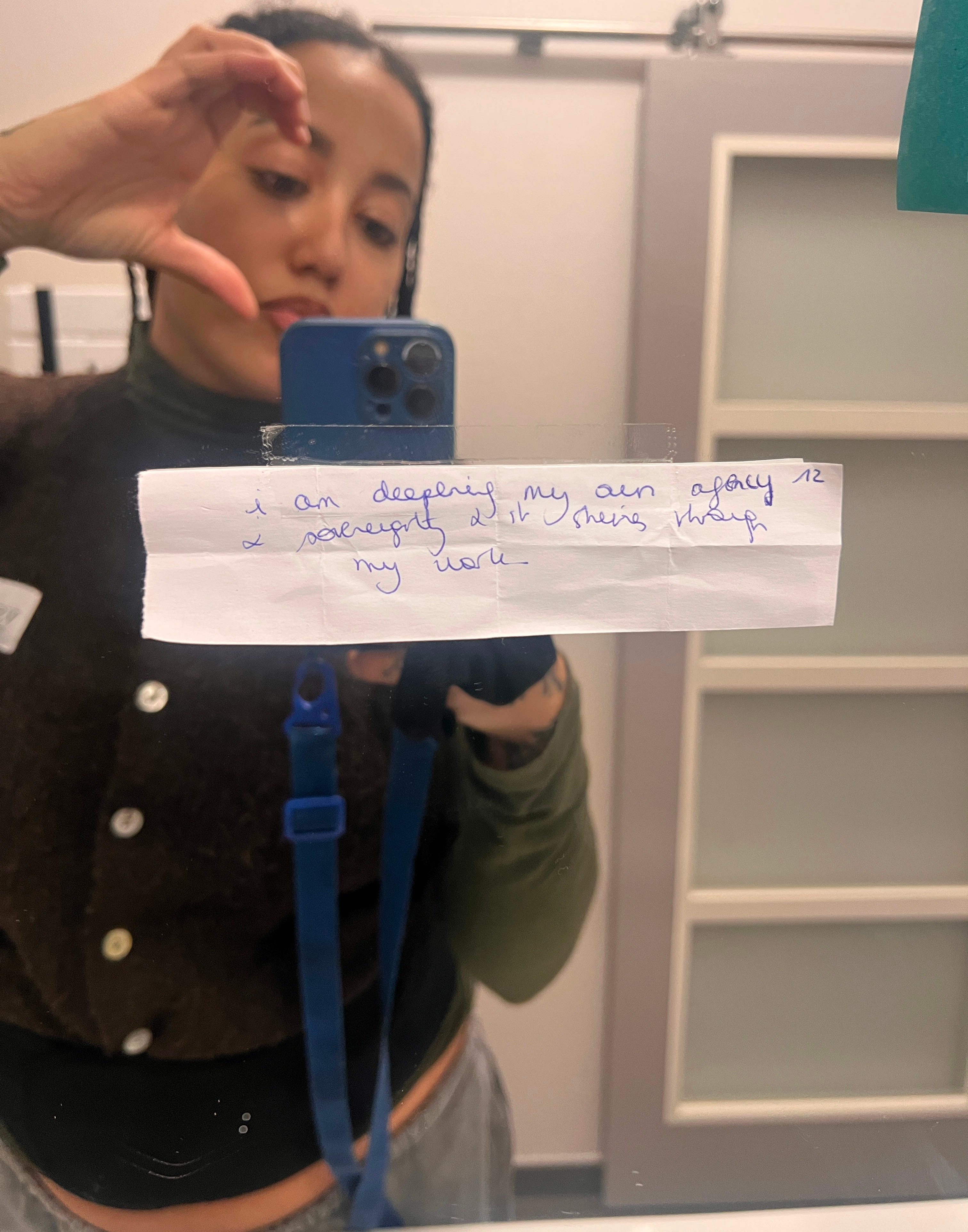
It is to deepen my own agency and sovereignty so that it shines through my work.
That wish has been quietly rearranging me ever since.
Because maybe the issue was never boundaries themselves. Maybe it was that I tried to use them as identities instead of practices. Maybe I wanted boundaries to protect me from loss—the loss of others? the loss of my selves?—when what they actually ask of me is the courage to be known while holding the possibility of rupture. I think what I’m terrified of is the people I love leaving me when I open my skinsuit and wear it inside out.
And maybe this season—mushrooms, housing, grief, ritual—is not about becoming better at boundaries, but about becoming less attached to the versions of myselves that needed to avoid or overdo them (different sides of the same coin).
The truth is: I struggle with boundaries a lot because I struggle with intimacy. That’s it. That’s the truth.
So, deep breath: If you struggle to set boundaries, this piece is for you. I wrote this right after therapy, and I hope it serves you in ways all those texts and carousels about boundaries haven’t—yet. As always, I speak from the I. If this piece does not resonate: it’s fine. We’re just different. If that helps you: I am glad.
I keep telling myselves they should have known, when the quieter and more honest truth is: I didn’t say. I didn’t say I was hurt. I didn’t say I was uncomfortable. I didn’t say something in my body tightened, recoiled, or went still. I didn’t set a boundary when it was still small enough to be held with care.
Avoiding boundaries is not kindness. It is a refusal to risk being known in real time. It’s fear of intimacy.
I used to think my struggle with boundaries meant I was conflict-avoidant. Now I see that I’ve simply perfected the art of self-abandonment. I delayed truth until it hardened into resentment because resentment felt safer than vulnerability. Resentment preserves power without risking rejection. A boundary, by contrast, risks connection—it risks being seen, misunderstood, or even lost. So instead of speaking while repair is still possible, resentment accumulates quietly, preparing the ground for moral superiority later.

Over time, I’ve come to understand that boundaries are not just about self-protection; they are a direct line to my capacity for accountability. When I don’t hold my boundaries, resentment begins to accumulate.
It starts subtly. Something a friend says. Something they do. And I say nothing. I don’t say, “I don’t like that.” I don’t say, “Please don’t do that again.” I don’t say, “This doesn’t feel good in my body.”
I stay silent. I’m scared to set a boundary because I learned early on that boundaries threaten the relationship—and sometimes my safety within it. I learned that it was safer to abandon myself in service of the relationship than to risk the freedom that might exist outside of it.
But that self-abandonment doesn’t disappear. It becomes fertile ground for destructive conflict. What looks like patience or generosity on the surface is often deferred responsibility underneath. And freedom, whether we like it or not, is inseparable from responsibility.
Then something shifts. I realize this is not the past. This is now.
Trauma is not only stored memory. Trauma is also frozen adaptation, waiting for new conditions. And the conditions have changed: I am not a child anymore, I cannot be abandoned. What once kept me safe is now keeping me stuck.
So I need to practice something different—not because the old strategies were wrong, but because they are no longer true.
Later, when that same friend draws a boundary—often carefully, often out of love for our relationship—my body cannot hold it. The resentment I’ve been carrying for months finally spills out. My reaction is no longer proportional to the moment at hand. What erupts looks like conflict, but what is actually exploding is everything that was never named. Every boundary I failed to set. Every moment I swallowed my own truth.
This is where accountability collapses. Not because I feel rejected, but because I did not draw a line early enough to remain in relationship with myselves. Their boundary doesn’t just limit me; it confronts me with the boundary I didn’t set when I had the chance. It mirrors my own silence back to me, and my nervous system experiences that mirror as threat.
When internal boundaries are weak or absent, resentment becomes the substitute. And resentment is dangerous because it disguises itself as moral clarity while actually being deferred responsibility. It says, you should have known, when the truth is, I didn’t say.
For me, resentment is often closer to jealousy than to anger. It sounds like: “Well, I didn’t say anything when you did X last fall.” What I’m really saying is: I cannot hold your boundary because I cannot hold or speak my own.
When a boundary finally appears—but it isn’t mine—the one I should have set months or years ago arrives late, charged, absolute, and often absurd. It’s not a boundary anymore. There is no room for repair then, only punishment wrapped in layers of defensiveness. Accountability, at that point, can no longer be practiced. It can only be fled, or worse, inverted and turned against the other person.
When we lack internal boundaries, accountability doesn’t feel like care; it feels like annihilation.
When internal boundaries are absent, accountability is experienced as violence. Not because it is violent, but because the nervous system has no internal structure to meet it. Responsibility feels existentially threatening when there is no prior commitment to one’s own limits.
This is why internal boundaries are not about control. They are about connection. They allow truth to be spoken while it is still metabolizable. They keep repair possible because they prevent resentment from becoming the main carrier of meaning in a relationship.
Without internal boundaries, responsibility is lived as a threat. With them, responsibility becomes specificity. This action mattered. This impact was real. You are real. And crucially: something can change. You have the right to advocate for yourself without stockpiling pain as leverage.
[Note for myselves: STOP. STOCKPILING. PAIN.]
I keep returning to this teaching in my practice: children need 3 things:
Boundaries, which answer the question, Am I safe?—the body’s first signal that the world can be trusted.
Validation, which answers the question, Am I real?—that the feelings inside me exist and have shape and language in the world.
And empathy, which answers the question, Am I alone?
This is the part that continues to humble me as a somatic practitioner:
The hardest part of being human is not what happens to us; it’s feeling alone in it. Boundaries, when practiced early in the relationship and imperfectly, are one of the ways we make sure we don’t end up alone with our pain.
So the question I’ll leave you with is this:
I know you’ve been alone in your pain. Can your body tolerate not being alone in it? Can you stay in relationship with your pain long enough to let someone else meet you there?
As always, you are welcome to read more of my work around Transformative Justice, accountability and repair in my zines:


Stay ungovernable. Let us see your pain—we’re not strangers to it!
Care
Really vulnerable, really beautiful
❤️❤️❤️