

Have you ever heard of this psychological phenomenon called pareidolia?
It’s the tendency to perceive meaningful patterns where none objectively exist.
Our brains hate ambiguity. Humans like to predict because not knowing is just too painful, so we see faces in clouds, animals in rock formations, religious figures on burnt toast or tomatoes. Our brains are prediction-making machines. Faced with uncertainty, they would rather invent a pattern than remain in the discomfort of not knowing.
I sometimes wonder if we do something similar in our relationships, like, emotional pareidolia? Let me explain.
Before I do!
If any of my writing has changed the way you think, imagine what practicing together could change. Join us before September 10 to be part of my first live 28-day course. 💌 On September 10, we begin Becoming Conflict Secure, my first live 28-day course on Substack. If you’ve been waiting for the right moment to become a paid subscriber, this is it: this course, originally priced at 57 euros, is FREE for my paid subscribers. Every day for 28 days, we will practice what it means to become conflict secure and see each other live every week for questions and integrations! Come join us!

For 28 days, we’ll practice together. Every day you’ll receive a short video, reflection questions, and a somatic practice to help you build the capacity to stay connected to yourself and others during conflict. We’ll also meet me live every week so you can ask me questions and practice in community.
I want to be clear! This isn’t about becoming better at arguing. It’s about becoming someone whose nervous system no longer experiences conflict as a threat to survival.
If you’ve ever frozen, people-pleased, shut down, over-explained, disappeared, or exploded during conflict, I made this for you.
And the best part? The entire course is included in your paid subscription! There’s nothing extra to buy. Join us as a paid subscriber now and come as you are on September 10, and we’ll begin together!
I can’t wait to practice alongside you!💛
Lately, I’ve been thinking about what my therapist calls markers of relational productivity. I’ve realized that because I’m queer, I don’t want to get married, I don’t want children, I don’t even want to live with a partner, and I am not monogamous, I don’t have many of the milestones our culture has agreed to recognize as proof that a relationship is “working.” My relationships won’t naturally produce engagements, weddings, mortgages, children pointing toward the next step, or any of the familiar signs that reassure us we are moving in the “right” direction. They don’t generate the kinds of evidence our culture has been taught to celebrate.
I don’t reject monogamy because I think it is inherently oppressive, nor do I believe polyamory is the answer to our relational wounds. Like every system, neither one saves us. Systems don’t heal us; they reveal us. Every relationship structure eventually exposes the practices we have rehearsed for years: how we relate to (mostly) power and care, but also jealousy, fear, repair, grief, longing, commitment, honesty. We don’t become different people because we enter a different relational structure. We simply bring our nervous systems into a new one. We are not our values, we are what we practice most.
What is interesting about my relationship to monogamy—or perhaps more accurately, the religion of the one—is that unlike so many other things in my life, I haven’t had the chance to integrate it by actually getting the thing I so desperately wanted (or, more perhaps, the thing I was taught to want), only to discover that it couldn’t save me.
I have never been in a long, beautiful, secure, monogamous queer relationship. I don’t know what it feels like to wake up next to someone and think, this is my person!, and to keep thinking that for years. I have never been able to recognize one person as a solid anchor in my life, go through challenges together and grow despite the world, feel chosen and wanted, and realise that life is still… lonely at times. I never got to climb the mountain only to realize the view wasn’t what I imagined, you know? My best integrations come from getting exactly what I want and realise that it will not make me happy… at least forever. Only through this process of getting exactly what we want and still be miserably human can we realise that no one is coming to save us (which is key in abolition work!), and that happiness is certainly not the point of a human life.
What I’ve had to do instead is grieving the mountain itself. I’ve had to stop trying so hard, which, is not the easiest for me. You see, I am team chalant. And I am quite type A (writing this makes me want to throw up, but that’s the truth). What I am trying to say is: I struggle to receive. I struggle to surrender. I struggle to believe that I won’t have to go without. And so I am certain that if I don’t do it, no body else will. The problem is, while this works great in business, it doesn’t work AT ALL in relationships. Business requires strategy, love requires surrender (!). One can only surrender when we trust that support will find us. I don’t trust that it will.
So what I’ve been doing the last two years or so is slowly dismantling the religion of love as it was taught to me. I’ve had to question whether the longing belonged to me, or whether it had been force-fed to me by a culture that insists there is only one way for love to become meaningful.
That kind of integration feels very different. It isn’t the kind that comes from postponing our happiness to reaching a milestone or getting something and realizing when we do that that’s not it. Integration from a space of lack, having to turn away from the religion because it has become more hurtful than anything hits different in the body. I am learning to loosen my grip on an ideal I never got to touch without becoming bitter that it wasn’t mine, ever.
Here we are again: dismantling the illusion of ownership! And as you know, learning to compost that illusion in our soma is a deeply political project. Our fear and insecurity can easily become a longing for absolution through another person, through land, through ownership itself. That longing sits at the root of so many forms of domination. Ursula K. Le Guin said it better than I ever could: “Walk here, sleep well, on the ground that is not yours, but is yourself.”
Instead of asking how we can possess one another—or the land—what if we asked how we can belong to each other without ownership?
To live in the practice of this question is the abolition work we should all be on.
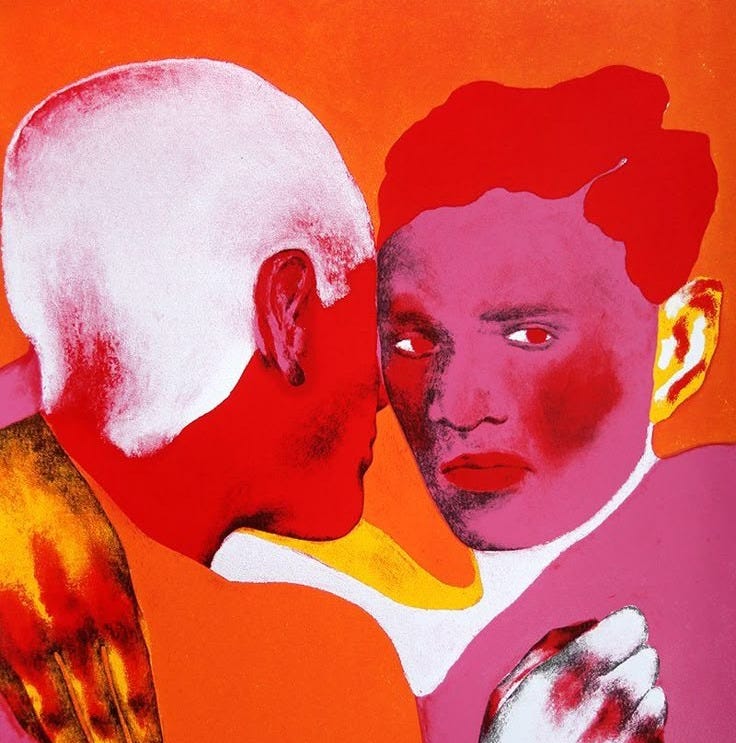
I understand why monogamy feels so reassuring. One of its greatest strengths is that it arrives with a script. So many expectations have already been negotiated before two people even meet. Both arrive with a common language and know what counts as betrayal, commitment, exclusivity, fidelity, partnership. Progress often requires very little conversation because the culture has already had those conversations on our behalf. There is a profound comfort in inheriting a map instead of drawing one from scratch, especially under material conditions that become more and more scarce. I suspect that much of what people experience as security is sometimes less about intimacy than about certainty. Security and intimacy are near enemies. If the rules are already written, we can mistake following the script for deeply knowing ourselves and one another. We can confuse identity for personality, or our hunger for status for our truest desires.
When culture gives us preconfigured, recognizable markers—marriage, exclusivity, cohabitation, children—we don’t have to wonder very much about what a relationship means because meaning has already been attached to those milestones. All we have to do is reach them. But when those markers disappear, as they often do in queer or non-monogamous relationships, our brains begin searching desperately for other signs (or create meaning of the cloud).
Even though I’ve never proposed to anyone, never wanted to move in with a partner, and never dreamed of building the kind of life that heteronormativity promised me, I have still found myselves desperately looking for reassurance that my relationships were ‘real’, or ‘serious enough’. Writing that now, I have no idea what it actually means. All I know now is, I’ve caught myselves escalating relationships, mostly with words, because I couldn’t tolerate the uncertainty of simply being inside them and surrender to what they are now. I wanted definitions, promises, declarations, futures.
Looking back, I don’t think I was chasing commitment nearly as much as I was trying to escape intimacy with myselves, the fear I felt, the tragic and tender violences of love.
Escalation became a way of soothing my own anxiety rather than deepening the relationship. It allowed me to bypass the hardest truth love has to offer: love was never designed to reassure us. Love is, and has always been, a risk. I also think that I was escalating because I simply couldn’t sit with my feelings at the time.I've loved people so deeply that reaching for bigger words allowed me to avoid feelings that were simply too big for my body. I think experiencing that depth of love forced me to confront the truth that I was actually lovable. And that was much scarier to practice in real time than the script I had been rehearsing for decades: that I was unlovable.
If looking up at the sky and finding faces in the clouds is pareidolia, then constantly asking, What are we? might be our relational version of it: a brain trying to make certainty out of ambiguity.
I am not saying that it is not acceptable to ask for clarity. Clarity is kindness. And, I guess our broken hearts can both attest to this: we can plan all we want, but relationships can only unfold over time. It’s like purpose: you’ll only know what your purpose was once you’ve lived your entire life and you’re dead.
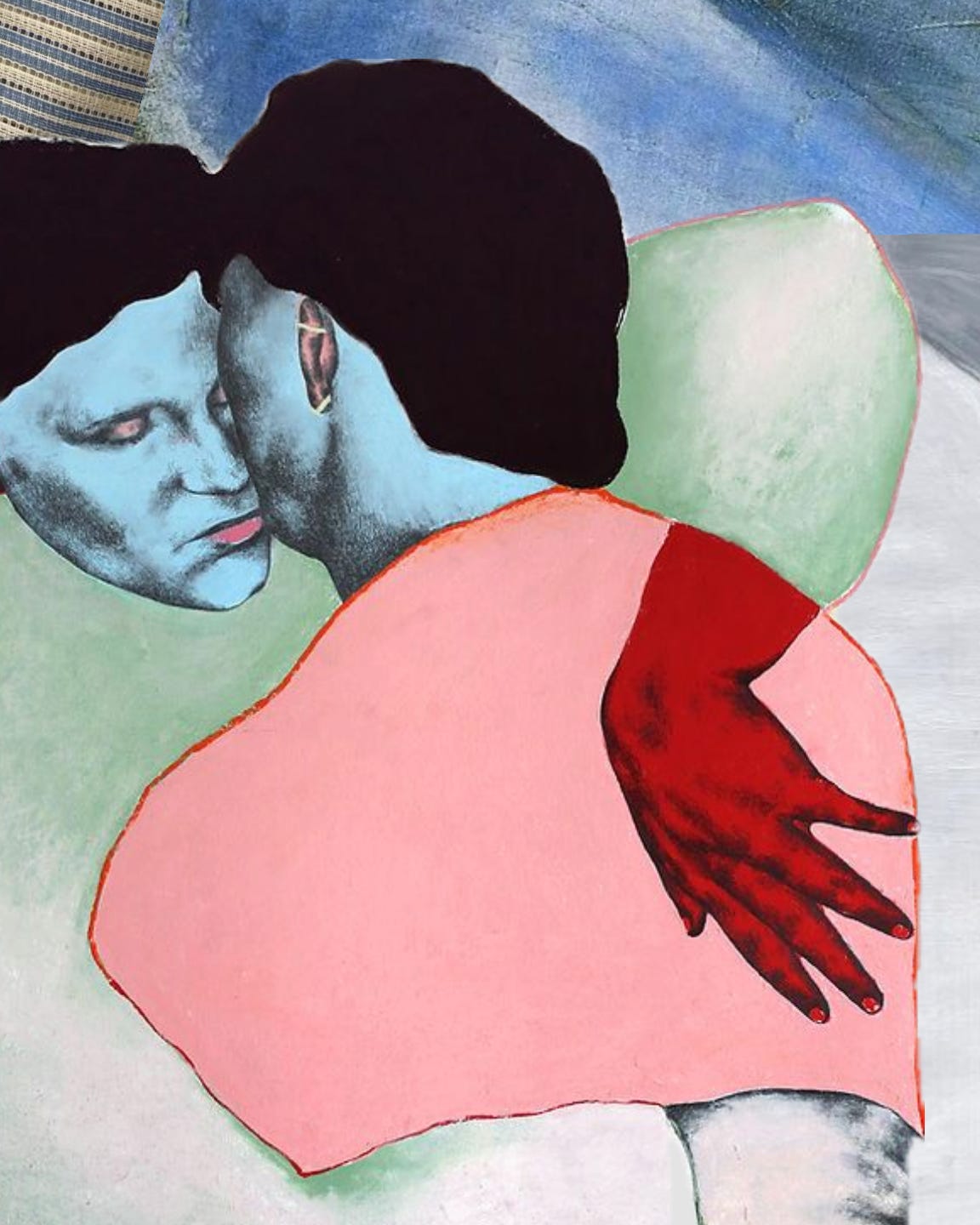
If we want to stop following a script and let our relationships unfold, the good news is that somatics has a lot to say about it.
Somatics teaches us that we can’t simply stop a habit our bodies have practiced for years. We have to replace it with another practice that meets the same need, only more truthfully, so that the body eventually chooses it instead.
When I ask myselves what I was trying to secure through monogamy—or perhaps more accurately, through the religion of the one—I realize I wasn’t actually looking for marriage (although I look so good in a suit) or living with someone and smell their poop first thing in the morning or unload the dishwasher together. I was looking for security, comfort, certainty, and control.
The problem is that I no longer believe those things can ever truly be given to me by another person. They are illusory guarantees, and our attempts to secure them have shaped some of the most violent systems on Earth. Those guarantees dissolve the moment life reminds us that we are finite, unpredictable creatures.
What has helped me is thinking in terms of near enemies.
The near enemy of security and comfort is safety. Not the kind of safety we’ve turned into a political weapon—safety is inherently relational: it emerges because we stick to each other. Safety is possible when two people become increasingly capable of honesty, repair, dignity, and care. It is possible when our nervous system know that our mistakes will not be used against us for punishment and exile, that being human is not a liability. It doesn’t promise you’ll never deal with the consequences of our actions or even be hurt, but promises you won’t have to face hurt alone, and that your safety, dignity and belonging will not be taken away from you. I want to be clear: there isn’t much absolute safety on this planet. We are all here to die. We cannot build a life that protects us from loss. Safety isn’t absolute, it’s relational.
The near enemy of certainty and control is connection. Connection asks something entirely different of us. It doesn’t ask us to predict another person. It asks us to keep meeting them. Again and again. It asks us to surrender the fantasy that love can ever flirt with possession and to practice relationship instead.
The goal isn’t to find certainty in others, but to build relationships that make us more capable of staying connected in the presence of it.
This is perhaps one of the greatest gifts of queerness. Queerness is, by design, collaborative. Queerness doesn’t only demand to stop inheriting relationships, it requires we begin creating them. Monogamy offers a map. Queerness often asks us to draw one together. Either guarantees intimacy. One simply arrives with culturally inherited markers, while the other requires us to co-create them, conversation by conversation, practice by practice, repair by repair.
I am done with markers of relational productivity. I want markers of relational depth.
So the questions I am trying to live in/practice now:
how do I measure my relationships differently? Although asking better questions truly excites me (I am a sag rising after all), living in their embodied practice and witnessing my life change before my eyes excites me more. Ideas, if never practiced, are just that: ideas in the ethers.
Instead of asking where this relationship is going, what I am trying to ask now is: who am I/are we becoming because it exists? I want to date people who inspire me to up my game a lil!
Instead of measuring relationships by what they produce—marriage, children, exclusivity, cohabitation—I want to measure them by what they practice: Do we practice more compassion, more care, more depth, and more alignment with our political values, or does this relationship become an escape from them/the world? I want my relationships to root me deeper into community and purpose!
How much freedom becomes possible between us? Freedom is responsibility, and so here I am thinking about freedom as in responsibility and care, not carelessness and I’ll-do-whatever-I-want kind of attitude!
How much truth can we tell? How much repair have we learned? How much dignity does this relationship make possible? How much more capable have we become of loving ourselves, each other, and the world?
Most importantly: I ask every single person who enters my life to co-create a map with me of our care. What does depth mean to them? Where do we meet without disappearing into each other?
If relationships are where we learn emotional literacy, conflict navigation, and deepen our capacity for care, they should be a stepping stone for us to be able to distribute care wildly, so it’s not just personal, but political.
It makes sense that heteronormative culture would teach us to evaluate relationships through productivity. After all, the nuclear family was never simply a romantic ideal; it was also an economic institution designed to organize inheritance, property, labor, and the transmission of wealth. Productivity has always been built into the model so that the financial elite keeps their financial power over us. But if abolition has taught me anything, it is that the value of a relationship cannot be reduced to what it produces. It has to be understood through what it practices, how it transforms us and how untenable it makes systems of domination and supremacy.
If abolition is the practice of building the world we all want and deserve, our relationships should help us rehearse the kind of people we want to become to birth it. Relationships are not meant to prove our worth. They are meant to transform our capacity for care.
Stay ungovernable dear one, fall in love more (with yourselves!),
Care
If you like my writing, consider sending it to a friend and/or better yet purchase my zines/ courses:


I really liked your definition of a good relationship— but one thing that made me sad about this article is that you seem to have given up on security or feeling like love is not a risk. I felt that way too at one point, but at this point I have some people in my life who I trust enough to feel secure around them. I’m afraid they will die, I guess, but I’m not afraid they will let me down in significant ways. Maybe stay hopeful that is possible and remember you deserve that?
This quote has changed me forever “We are not our values, we are what we practice most.”
I spend so much of my time beating myself up for not making decisions that align with my values, it’s sneaky and slippery and hard for me to see the misalignment until afterwards no matter how long I mull it over beforehand.
This idea gives me hope that as I practice secure skills it’s possible to make decisions differently, in a way I’m proud of that’s ethically aligned and equitable. Thank you ♥️