

There is this belief that queer folks are better at relationships than non queer people, especially if they identify as non monogamous. Here, I’ll use “queer” in its original sense—strange—for those who have developed different ways to relate to themselves and each other (that includes and centers non monogamous queer folks).
While it’s true that queer people are uniquely positioned to build deeply transformative, liberatory relationships—shaped by the friction we face in a heteronormative world for who we are, how much we’ve committed to unlearn and who we choose to love—many of us also come from heteronormative (& fucked up) family systems, all while navigating a world that seeks to render us invisible at best, and destroy us at worst.
Yes, we’ve built intimacy in worlds not made for us, because intimacy is our legacy. Yet simple doesn’t mean easy.
Queer people are also leading and central to liberation movements but are often unsupported in the most intimate parts of their lives. We are burning out from care work, political work, and the emotional labor of love, all while lacking models for grounded, liberatory relationships. We're less paid, less housed, and often only have access to therapists (if we’re lucky) who—most of the time—don’t understand how we relate to ourselves, others, and the world. A lot of us don’t have access to our queer elders. Our communities are fractured, weighed down by conflict, fear, shame, and policing.
What I’ve seen over and over, is that this isolation leads to higher rates of mental health crises and burnout, even as, especially because we lead the charge for systemic change.
I know from my somatic work that the hardest part of any experience isn’t the experience itself, but living through it completely alone. Being able to reach to someone after witnessing a car accident, for example, can reduce our chances to develop CPTSD (Complex Post-Traumatic Stress Disorder) by up to 50%*.
It’s not just the traumatic experiences that linger in our tissues for years or generations; often, what stays in our bones is how much access to help we’ll have when something bad happens.
Being queer, trans means, in some shape or form, living on the margins. And while permaculture has taught me that growth happens on the margins, and I know that we’ve built heavens there, growth is also so damn exhausting, even more so alone (I love Black excellence and all, but can we reach for mediocre, like from time to time?).
Queer and trans folks are expected to heal, love, organize, and care—all at once—without deep relational scaffolding.
Yes, this tension queer and trans folks experience in the world—building deeply transformative, liberatory relationships, while living in the het world— births relational genius. Queer relationality isn’t just survival, it is a strategic site of world-building. That relational genius becomes the premise on which we build our liberation movements. Or at least I believe it should!
But in practice, I find that it also makes relationships harder, lonelier, and often more precarious. We’re asked to survive, organize, and liberate without the deep, sustainable support systems we deserve.
During the last workshop I created around those topics—titled My Queer Relations: an experiential workshop for queer people to explore, discuss & reshape the ways in which we relate to ourselves & each other, despite trauma—folks in the chat decided to create a group chat to keep talking and sharing around what it means for us to love and be loved, despite trauma. I created this space because I find that, like many of you, I lack spaces where I can talk about my relationships in a way that is deeply political (because they are!), while also centering my organizing work, the work I do for my communities, sex, money, flirting, housing etc.
I crave spaces where we can talk openly about how access to housing and money shape our capacity to date. About desirability politics, colorism, classism, ableism and transphobia in a queer world obsessed with Billie Eilish and Kristen Stewart. Sigh.
I want to talk about flirting and dating, yes—but not without acknowledging how the ongoing extraction of Black, trans, and queer culture mirrors the gentrification of our cities (hey Billie, can you run up our styles real quick?). I want to dive deep into the somatic effects of how our language, style, rituals, and brilliance are lifted, aestheticized, and sold to white queers as the way to enter the queer world, while Black trans people are pushed out, erased, and kept at the edges of the very world we created through love and survival.
I want to have public conversations like: Why is it that Black couples are often made up of a light-skinned Black person and a dark-skinned Black person (or, of course, two light-skinned Black folks)? I want to know how racially diverse relationships handle racist uncles—do y’all just avoid family, or do you introduce your partners as friends? I want to understand how asexual folks navigate polyamory. I want to meet people who understand that framing polyamory as a matter of need (I can’t stand hearing white folks talk about how one person couldn’t meet ALL their needs, I swear) instead of a matter of care (17 people wouldn’t either!) is really exploitation disguised as polyamory.
I want to talk about engaging in polyamory in ways that don’t reproduce the racial and extractive systems we all suffer from unevenly.
For a while, I thought that my intimacy issues were the reason why I didn’t have 17 partners like a lot of people around me in Berlin. I wondered how people dealt with communicating so much, fucking so much (if they do) AND paying rent to the white landlord. How??
Like I’ve said in my last post, How Neglect Wires Us For Obsession, I want to share my wounds, not when they’re healed, because that’s too neat and easy for me, but when they’re raw, still bleeding, and seeping deep into the bottom of my soul.
I also want to face being wrong about my wounds around being loved, because I do believe that healing means losing the identity we’ve built around our pain.
I know there isn’t just one right answer to my questions. I also know that healing is not always about getting answers, but more often about asking better questions.
I recently asked on my IG stories if Black queer folks felt like they were always the crush but never the “anchor” or “nesting” partner (those words make me want to throw up lol!).
This is what folks responded:
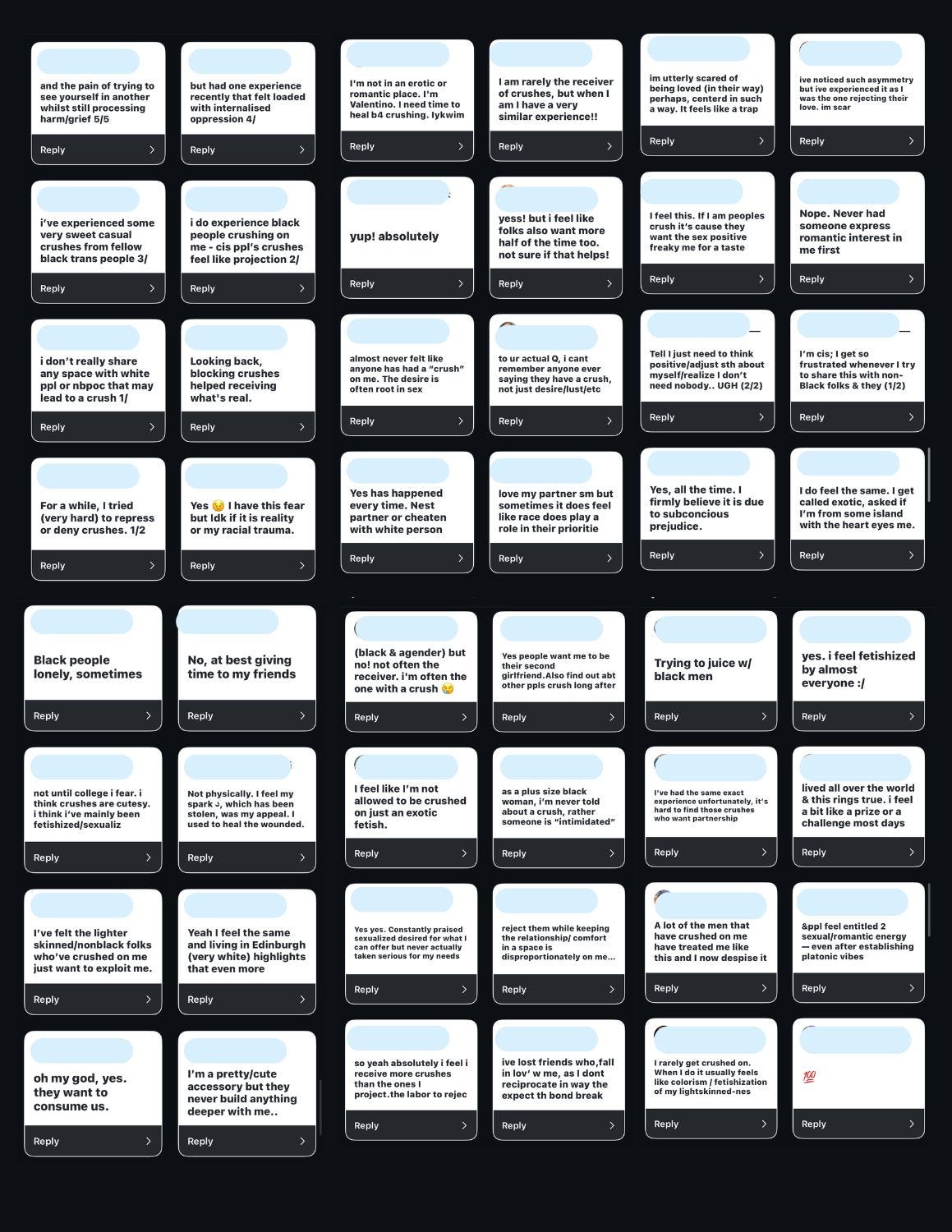
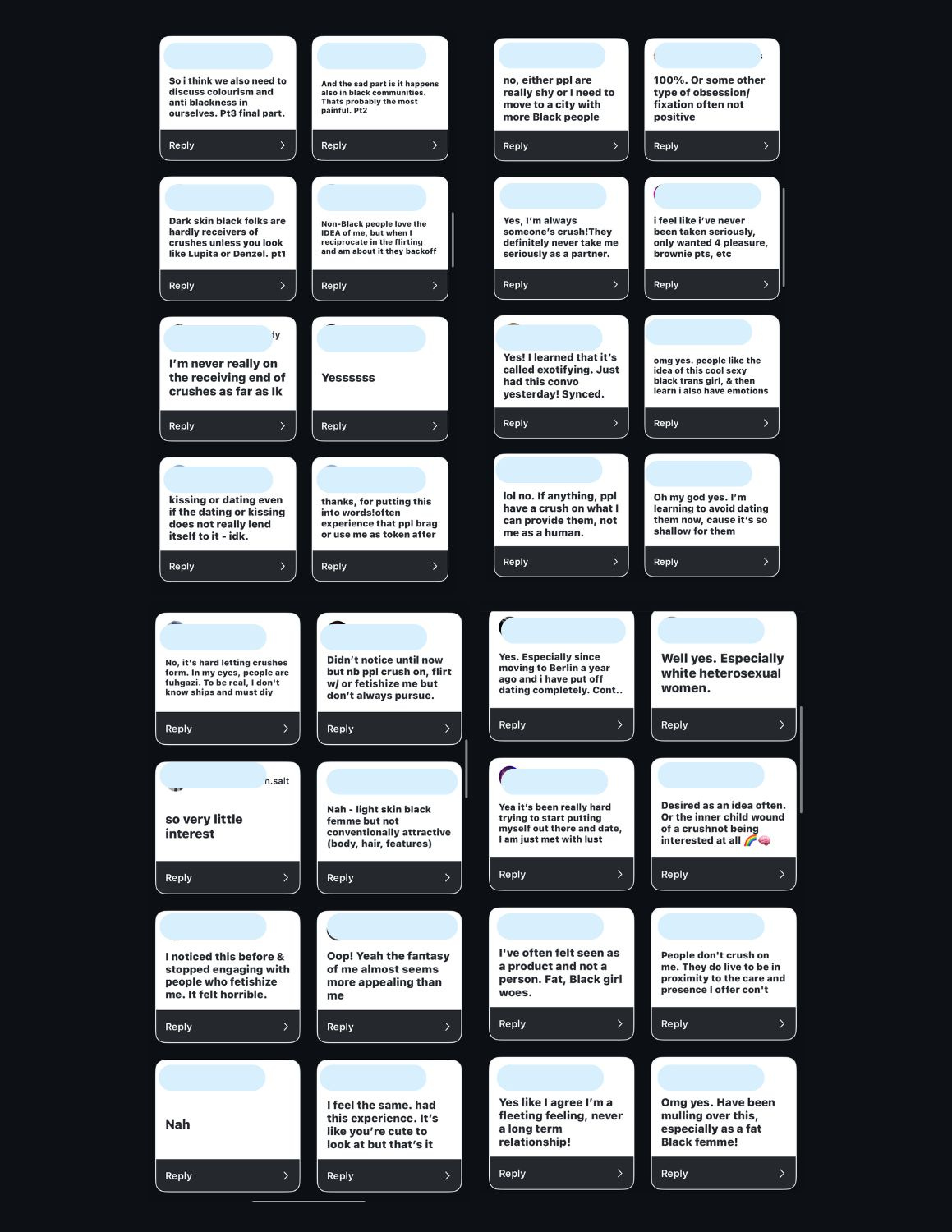
Thank you to everyone who responded !!
A lot of those answers made me realise why I got so mad when I saw another white queer of Berlin (who I often saw in BIPOC spaces) write this on Hinge:
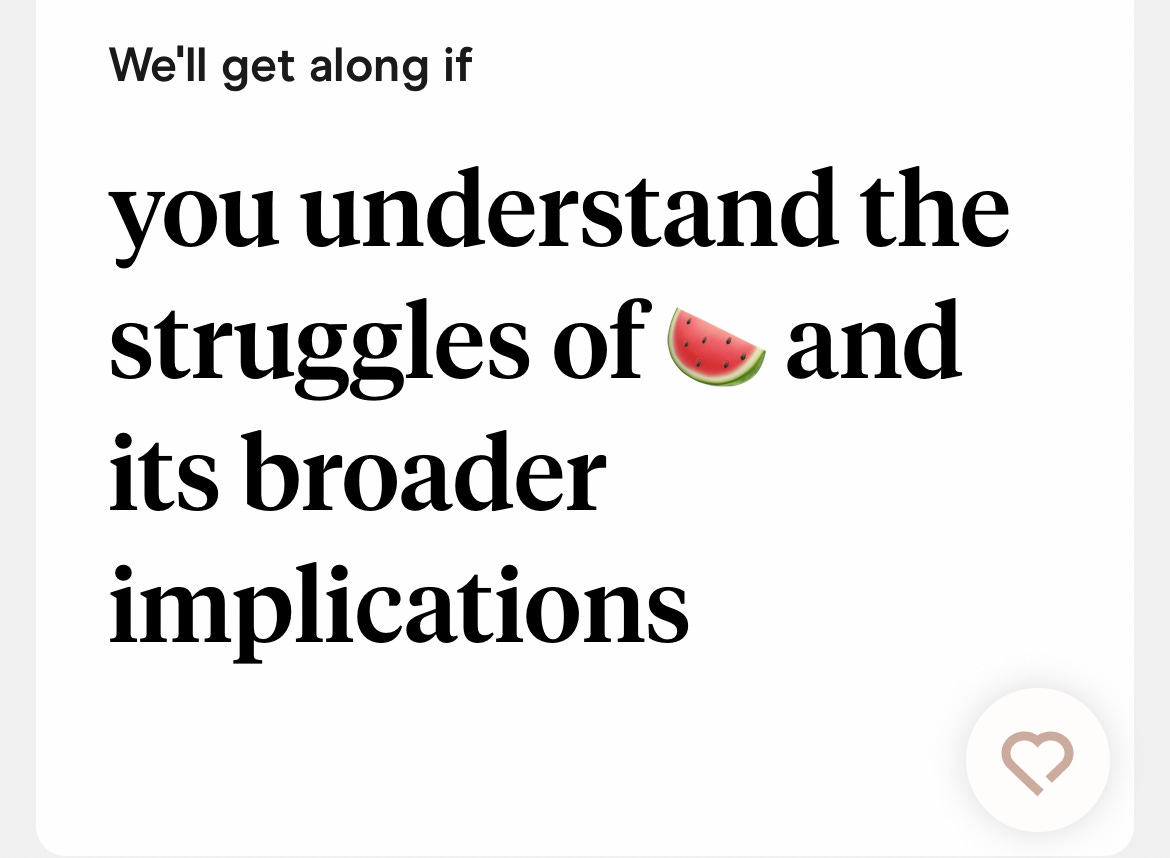

So you mean to tell me that to hang out with you I need to understand the geopolitical histories of structurally created genocides that affect Black and Brown people globally, but any exchange should be sweet and shouldn’t have any eXpEcTatiONs?
Now y’all, I swear: I am a reasonable babe, but am I missing something? Or is this just the white queer version of bare minimum—seasoned with a sprinkle of politics and just enough awareness to get Brown pussy? Cause damn.
I think it’s fair to say that asking people who have been structurally and globally unloved to have no expectations—no hopes—for where they might finally find a sliver of safety, care, or love is maddening, at best. It’s not just unreasonable, it’s inhumane. I am kind of terrified by the lack of understanding that white queers have around what it means to date Black and Brown people who come from generations of trauma and displacement they benefit from.
AND, I have loved a white trans person once. I honestly wonder how others make it work. I’ve started to think that folks love our looks but not the consequences of how we look.
That led me to write in my Transformative Justice zine:
“When we desire to reap the benefits of an emotional bond with someone without showing up to the difficult but necessary task of acknowledging, addressing & unlearning the societal dynamics that affect their relationship to their sense of self as well as the relationship between us, we are not ready to be in relationship with this person. That dynamic mirrors the one we have with our home, planet Earth: an exploitative, extractive dynamic that doesn't care about reciprocity nor mutuality. we need to change that. And that starts with our relationships (we can't be abolitionists AND conflict avoidant y'all).”
Welp, I don’t have a lot of answers y’all, again. I do however think that we owe each other better. Much better.
My work on this corner of the internet is to bridge the gap between the personal and the political by asserting: abolition lives in how we love, disagree, repair, and grow together. Those conversations aren’t just self-development—they’re political warfare against a state that thrives on us being disconnected, numb, and isolated. I’ll never say it enough:
abolition is a relational practice.
If you’re interested in joining my next workshop, My Queer Relations, you can fill this form. You’ll be the first to know when I am ready to dive deep in those themes with you all again. In the meantime, I’ve written a zine about it, and you can find it here.
Sending care
Care
*Having someone to call or talk to— right after experiencing something traumatic— provides a sense of validation, safety, and emotional connection, which can help regulate the stress response. In some cases, the presence of supportive individuals has been shown to reduce the impact of traumatic events by up to 50%, as it mitigates feelings of isolation and enhances emotional resilience. However, it's important to note that other factors, such as the nature of the trauma, personal coping mechanisms, and access to therapeutic resources, also play significant roles in preventing or mitigating CPTSD.
Thank you for your nuances and depth which competently tie together so many relational complexities in the queer polyam world. The conversation about extractive polyamory is necessary (bc it is so racist, desirability centered, and is classist... etc). Esp regarding resources- and how ppl believe its inherently libratory to shop for intimacy and discard partners when resources are threatened or frankly, when it gets hard. Ppl seem to care more about optics and how many partners they have than longevity ecosystems and repair cycles/ politics of care. How does that confront hetero patriarchy and how is that liberatory?
This is so poignant! I’ve wanted to write something just like this. The whole no-expectations mindset when dealing with structurally unloved racialized but esp black ppl really IS inhumane and intimately cruel. I love your mind, thank you again.