

I’ve said it here before: money isn’t about numbers. It’s a story your nervous system carries. When you tell me your money story, I start to trace the contours of your ancestral story — your access to resources, safety, care. I can often situate your lineage in time, uncover the colonial stories behind the displacements and movements you and yours have lived through, and see how all of that shapes your relationship to abundance today.
Money is embodied history. Scarcity lives in muscle tone, breath patterns, vigilance, dissociation. Before a single financial decision is made, the body has already reacted.
When you tell me your money story, and I pay close attention to your shoulders, your breath, the movement of your hands, I can often sense your relationship with care, reciprocity, and how supported you feel in the world. I can almost always tell when someone has carried huge amounts of neglect in their lives, whether structural, personal, or both.
Before any of us learned what money was, we learned what was tended to — and what was not.
Neglect is not only personal.
It is structural, political, intergenerational.
It is the first curriculum in scarcity.
A body raised in neglect learns to organize around absence:
absence of consistency
absence of safety
absence of being held
absence of enoughness
In other words, money is where capitalism meets the body.
Because long before we make any financial decision, our biology is already reacting. Our relationship to money is shaped less by math and more by:
what we were allowed to need
what we were punished for wanting
what we were taught to fear
what we had to survive without
I know now enough to say: Scarcity becomes somatic architecture.
A neglected child becomes an adult who prepares for disappointment before they prepare for possibility.
A structurally neglected community becomes a collective that strategizes around threat, extraction, and endurance. And god knows we feel it when conflict arises between us.
A globally neglected majority is told to and learns to stretch, suppress, overwork, overgive, disappear, or collapse.
So my first questions to you are;
What weren’t you allowed to need?
What were you punished for wanting?
What were you taught to fear?
What did you have to survive without?
I’ll start!
What wasn’t I allowed to need?
I wasn’t allowed to need rest and support unless I was physically sick. Now as a somatic practitioner I meet so many kids — now turned adults — who are chronically sick and when I ask a few questions about their past, I realise that they only got to receive care when they were physically sick. They come to see me and doctors keep telling them there is nothing “wrong” about them. We know that doctors don’t believe us and so I ask them to keep looking for answers, but soon enough, I find out that the only way they received care was when they couldn’t provide any. When they were bed ridden, or when they had fallen from their bike and had to stop running everywhere for a week or two.
What was I punished for wanting?
I was punished for wanting to be big, to be smart and to be well/ succeed better than my mother. A black female child who thinks they’re smart? PFFF ! wait until you meet the world. The world breaks females. And I mean, she was right.
What was I taught to fear?
I learned early that big feelings were dangerous—unless they were anger, because anger still had strength sewn into it.
It makes a lot of sense. Anger is rarely the only emotion. Anger is often a cover up, a translation, a bodyguard, a valve. Because under anger is: hurt, fear, fear, disappointment, longing, shame, unmet needs, loneliness, feeling powerless, feelings small.
What I truly need(ed) was/is:
attunement
someone who could handle my intensity with steadiness
permission to feel sadness without shame
someone who could say “you’re safe with me, you don’t have to be strong”
a place to fall apart without being punished
adults who met my tenderness with warmth, not fear or rejection
someone who said:
“Your big feelings don’t scare me. I’m here.”
What did I have to survive without?
I grew up surviving without a safety net. When things were frightening, calling my parent only invited a new collapse. There was no one to lean on, so—like so many Black femmes —I learned to carry everything alone. I became hyper-independent because it was the only way to stay alive. Even until today, asking for help is not even an option. Someone usually has to place the idea right in front of me for me to even realise—oh, right… that’s actually an option people use.
In other words, my survival strategy is fight. I’ll immediately do something, anything— I’ll work towards the solution, find the silver lining under this mess.
What is yours?
Here are the survival strategies specific to money shame/fear:
✦ Fight
Overwork, perfectionism, hoarding, micromanaging, trying to overpower scarcity through sheer effort.
✦ Flight
Impulsive spending, jumping between jobs or cities, constant reinvention, never feeling “settled enough” to stay.
✦ Freeze
Ignoring bills, not opening letters, procrastinating on everything money-related, going numb when decisions are needed.
✦ Fawn
Undercharging, over-delivering, giving for free, apologizing for having needs, shrinking to stay liked or safe.
✦ Dissociation
Checking out entirely — scrolling, dreaming, fantasizing, zoning out during financial conversations, feeling like money belongs to “other people”, that this is not for us, this could never be us.
Living outside the body as a way to survive overwhelm.
Time slips. Tasks disappear from memory. The world feels far away.
Survival strategies are about survival, protection. They exist so we can survive this moment. They’re not about thriving. Before you go into your lil shame spiral on your own, i need you to read this over and over:
We don’t choose our survival strategies. When our system senses danger — real or imagined — the thinking brain goes offline and the survival brain takes over. The body chooses whatever response has kept us alive before.
This is how it works (put really really simply!)
1. We do not “choose” fight, flight, freeze, dissociate or fawn.
They happen before conscious thought.
2. The amygdala & brainstem react in milliseconds (!).
Much faster than the prefrontal cortex (thinking brain), because facing danger means no time. You understand now why racial capitalism looooves urgency, right?
3. Your system pulls from old survival templates
Whatever worked in childhood or past trauma gets repeated. So your money story is not just about money. It’s more so like this:
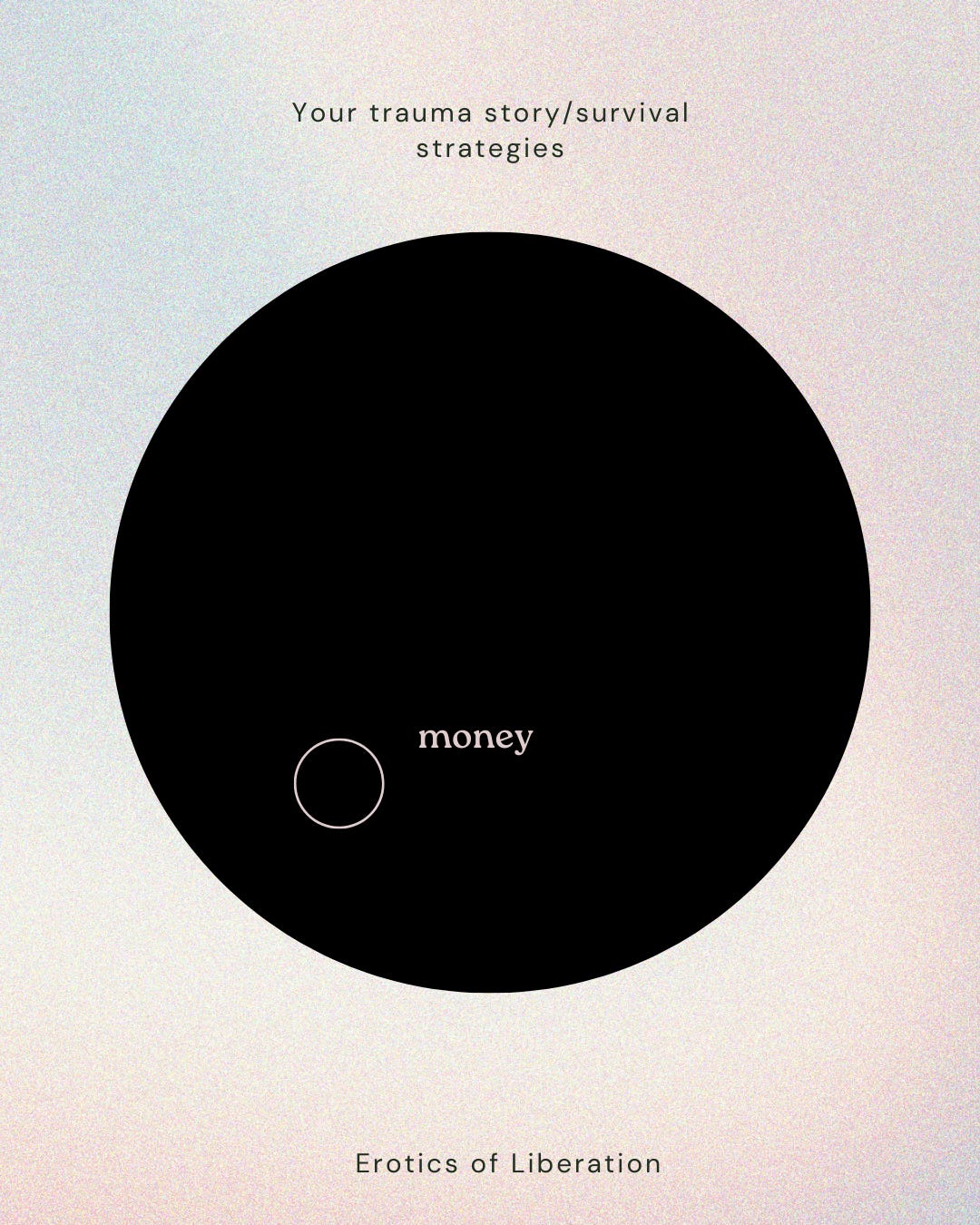
The way we deal with anything says something so much bigger about our whole cycle of trauma and our felt sense of our place in our (collective) body.
I am serious when I say: avoidance — when tended to — can unravel your whole cycle of trauma. There is so much power in being curious about our avoidance. This is where our power lies.
You keep avoiding money until you’re drowning because it’s easier to fight the current than sit with the truth that no one ever taught you how to float.
You ghost emotionally because you’re terrified of needing anything.
You overwork so you don’t have to feel.
You ask for nothing and resent everything: how dare they just ask for help? You’ve been doing this ALONE SINCE NINETEEN NINETY NINE !
You keep choosing people who leave you because you’d rather predict abandonment than risk intimacy.
You sabotage yourself financially because you’re afraid of becoming someone you’ve never been allowed to be, or someone your folks were never allowed to be.
4. This is why patterns feel automatic, shameful, or confusing
Because they’re not intentional — they’re protective reflexes. Like your leg going up when the doctor taps on your knee.
So, Care, what do we do with all that? you may ask, dear one. This is where it gets real juicy; because this is where we invite the opposite of trauma:
LA CURIOSITÉ.
(I thought you’d be less scared if I said it in French =)? )
Becoming curious about your survival strategies allows you to understand the need underneath. Because needs never die. You’re alive. You’re needy. Get into it.
So: what is your survival strategy trying to protect you from?
It’s rarely actual survival. Like a letter from the bank won’t literally kill you. You won’t completely collapse and die right on the spot if you open the letter. But keeping it closed on your kitchen counter for weeks will definitely turn it into a monster under your bed (or at least it will be a character that has legs in your nightmares).
Let’s take me as an example. I am a fighter. I’ll overwork when I am scared. I know deep down my overwork tendencies is just a gross yet — under racial capitalism — really valued way to distract myselves from the inevitable truth: I don’t have control. I’ll die. I am actually dying now, writing this post for you all. We all are. Everything I have ever loved will inevitably die and is dying. I came here with nothing and I’ll leave with nothing-er.
So you know what?! I’ll write something ! Logical, right?
It works for a little while, and then, then my precious body, always kind, shows me who is running the show. Then I get sick. Sicker the busier I make myselves. And it always happens. The more I do, the more sick I’ll be. I fall apart. And then all I can do is look at the ceiling from my bed, and I’ll question every single choice I have ever made, starting with the pack of tissues I bought and why they’re sTuPiD.
So, here are some clues for you, depending on your survival strategies:
✦ Fight
If you overwork, use perfectionism, hoarding, micromanaging, trying to overpower scarcity through sheer effort.
SIT. THE FUCK. DOWN.
Probably this is impossible for you. So walk yourselves towards the sitting. Walk outside so you don’t overwork. Talk to people (BUT NOT ABOUT WORK). Stop using every minute to make a plan. Stop it.
✦ Flight
If you suffer from impulsive spending, jumping between jobs or cities, constant reinvention, never feeling “settled enough” to stay.
STAY.
stay where you are. Know that this is as good as it gets. And make the best out of it, like you always have. You’re reading my words right now: you’re alive! You have 100% success rate. You’ve survived every heartbreak, every bill, every night you thought would break you. You are here—breathing, wanting, trying again.
Your body has not given up on you for a single day.
So don’t you dare underestimate the you that got you this far. You can do this, and I know this because you have. But if you keep avoiding those feelings of inadequacy, I don’t mean to scare you more my darling because I know you’re scared, but you’ll die believing you’re a coward. I am not saying you are. What I am saying is: when we avoid ourselves all together, we make ourselves the monster. And God damn, don’t nobody got time for that.
✦ Freeze
If you’re ignoring bills, not opening letters, procrastinating on everything money-related, going numb when decisions are needed.
You need to travel back into feeling, darling. Freeze, and then slowly move back towards your aliveness. Freezing is becoming death before it reaches us. You’ve seen it in movies a million times: it’s the shawty in the closet who stops breathing cause the serial killer just entered the room.
Money will not kill you. It’s life who will lol! (Probably cancer with all this shit we breathe and drink, so go out of the closet and show money who’s the boss!)
For real though:
Before you can face money, you have to come back online. So try this for 90 seconds:
Put one hand on your lower belly, one on your sternum
Inhale for 4 counts, exhale for 6
Feel your seat or feet on the ground
This interrupts freeze and gives your body a felt sense of “I am safe enough to take one small step.”and go forth, darling. Fuck the bank.
✦ Fawn
If you’re undercharging, over-delivering, giving for free, apologizing for having needs, shrinking to stay liked or safe.
You need Black female rappers. Stop being humble, like right now. Have you done the math around people pleasing? It’s a lot of it and NO BODY IS EVER PLEASED. It’s never enough.
So go do some white men positions in your living room: stand super tall, hands on your hips, look around like you’re a cop or the manager of this place. Let those legs, those hips widen out! In the comfort of your home/space/wherever you can: take. more. space. This is what I want you to do:
Fawning collapses your boundaries, so the path back to agency is about re-inhabiting yourself before you respond to others.
Here are a few sentences you can use:
1. Pause before saying yes.
If 10 seconds of silence is too awkward for you, break the automatic people-pleasing loop and let your body register what you actually feel by just saying: “I’ll think about it and will come back to you on it”. Nothing is urgent. We’re not saving babies. And this is a doula writing this.
2. Come back into sensation
Place a hand on your chest or belly and notice what it is that you’re actually feeling, and name sensations before feelings.
3. Practice micro-boundaries
Start with tiny, low-risk boundaries like “I’ll get back to you later.” Agency builds through reps, not grand gestures. We are what we practice, not what we think or what we value, remember?
4. Let the resentment speak as data
God knows, fawning queens are literal resentment data centers. If resentment is present dear one, it means you abandoned yourself somewhere. Trace back the moment you said yes without checking in.
5. Rehearse saying needs out loud
Fawning people regain agency by learning to voice small needs in safe relationships—warmth, time, space, clarity. Needs expressed in low-stakes contexts become capacity in high-stakes ones. Start with someone who cares about you and you care about.
✦ Dissociation
If you’re often checking out entirely — scrolling, dreaming, fantasizing, zoning out during financial conversations, feeling like money belongs to “other people”, that this is not for us, this could never be us. Living outside the body as a way to survive overwhelm. For you, time slips. Tasks disappear from memory. The world feels far away.
Dissociating is leaving because here (the body) is unsafe. So, try those:
Slowly return to the room, your body, and the present.
Ground yourself: wrap your hands around a hot mug of tea or coffee. Notice the warmth.
Move your body slowly: stretch, wiggle your fingers, feel your feet on the floor.
Remind yourselves (out loud if you need) that you are safe. That you can do this, because you have.
If you want to go deeper: buy my somatic reset guide here.
And if you want to dive even deeper, this is one tiny part of what we will be looking at during my next workshop!
The Somatics of Scarcity: Money, Safety, Worth & the Body is a 3-hour somatic workshop that rewires money shame into nervous-system safety, turning avoidance into agency and scarcity into dignity. If you are struggling with money, I want you to re-member: Financial patterns are not moral issues. They are somatic imprints created by structures that benefit from you living scared. You can rewire them, with intentional practice, so you can face money with dignity instead of shame.
This workshop is:
For the avoidant-but-high-functioning one.
For people who are responsible in everything except money.
For the ones who can hold everyone else but not hold themselves.
For people who are brilliant but ashamed of their finances.
For the ones who confuse emotional intensity with intimacy.
For the ones whose nervous systems are tired of survival.
See you there,
Stay ungovernable!
Care
Wow. There is so much treasure here. What a gift! Thank you 🙏🏻