

Up until recently, I was caught in the tug-of-war between the structural and the personal — between the vast machinery of institutions, histories, and systems on one hand, and the small, trembling sphere of individual will on the other.
I’ve always resented how, in many healing spaces, people bypass the reality of systemic oppression. They ask us to breathe deeper, to let go, to “manifest” — as if the problem were only inside our lungs, not in the air we breathe.
Yet in organizing spaces, I often felt another kind of dissonance. There, everything was structural. Every wound, every ache, every fracture in a life was laid at the feet of the system. My body resisted that too. It didn’t feel right to collapse all pain into politics, to erase the fragile mystery of our inner worlds.
And this belief was also misused to evade all sorts of personal
Accountability. You know your girl isn’t about that shit !
For a long time, I felt like I had to choose. And if I had to choose, I would always side with the structural — because the evidence is overwhelming. Where you are born, what body you are in, what name you carry: these things shape your life more than willpower ever could.
I know it because I was born in a part of the Paris banlieue no tourist would ever go.
I know it because I’ve seen what it means for my Congolese family to travel and be in the world.
Still, I judge myself for believing — even secretly — in the exception, in the plot twist, in the story of beating the odds. In France, we call it méritocratie — the myth that effort alone can rewrite destiny. It’s the French version of the American dream.
But maybe the question isn’t whether life is structural or personal. Maybe that’s the wrong binary altogether.
So here are some better questions (I hope ! what are yours????!):
• What happens when we stop trying to separate the structural from the personal, and instead learn to feel how they breathe through each other?
• How do systems live in our bodies — and how do our bodies, in turn, sustain or resist systems?
• What does healing look like when it includes both accountability and tenderness — when we honor the social without erasing the soul?
• How can we reclaim agency without denying the weight of the world?
• What stories do we need — not of merit, but of interdependence, complexity, and repair?
• And perhaps most of all: what would it mean to live as if freedom is not a solo project, but a shared practice?
What I know for sure is this: I believe in the weight of institutions because I feel them in my body, and in the bodies of those I love.
I’ve also witnessed how one small flame can brighten an entire world.
To me, the personal extends an arm’s length; the structural, a world’s length.
AND ALSO, when we reach for one another, the distance collapses.
Traumas still live in the space between us,
but I know—because history has shown it—that reaching across has changed the world before, and it can again. We’re reaching for each other again and again !
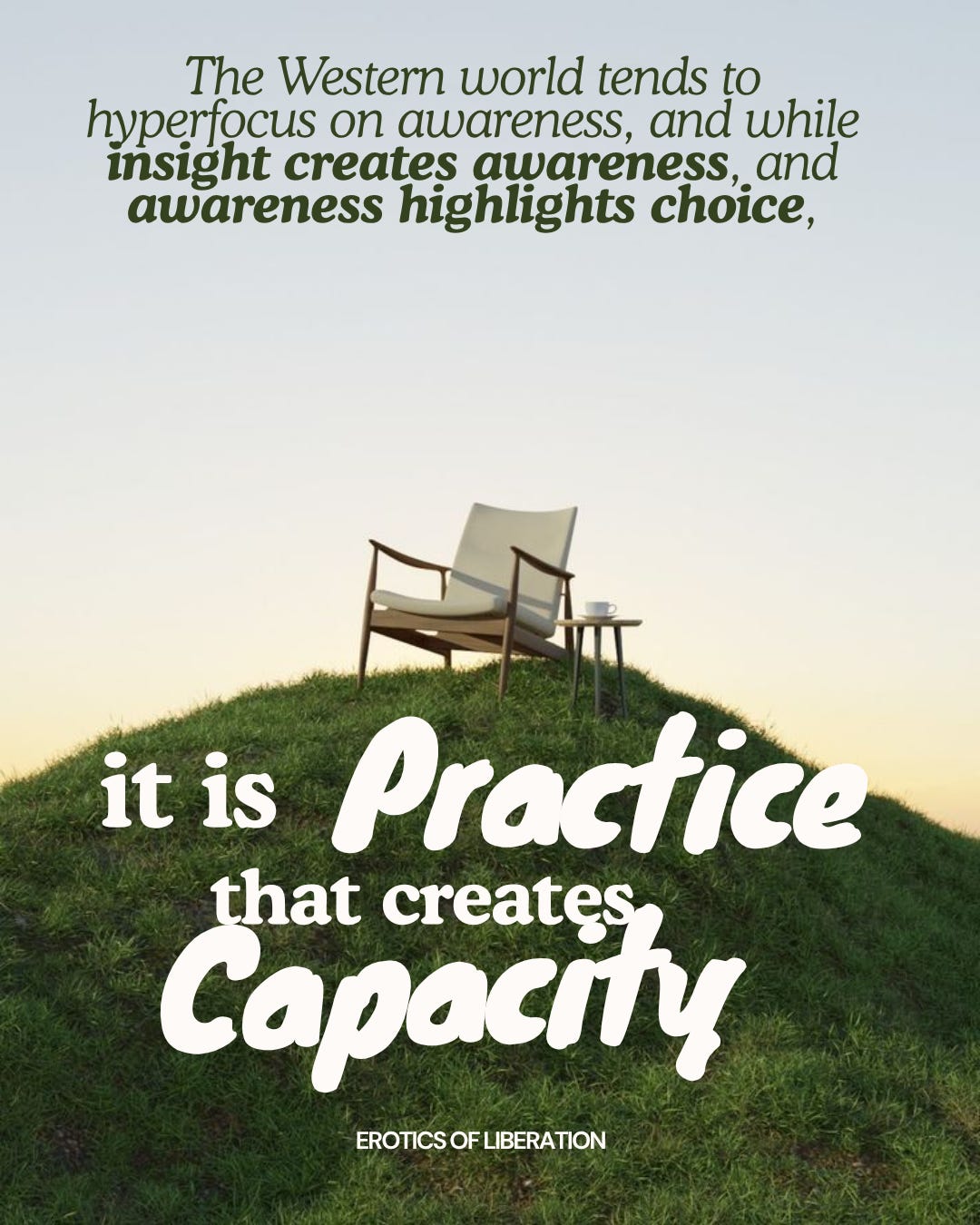
Liberation Practice Field is the first somatic program that centers healing as collective justice. If you are drawn to a radical approach to healing—one that integrates justice and directly addresses the effects of capitalism, colonialism, and patriarchy on our bodies and nervous systems, if you seek somatic education that deepens your understanding of how trauma shapes the body—not just individually, but collectively, if you desire to learn embodied practices that help reconcile systemic wounds… this program is for you.
Liberation Practice Field is an invitation to stop waiting for the right conditions and begin living the world you long for — together, in accountable community.
It can be both structural and personal! I find that activism is at its most empowering when we think about both.