

This is the second part of an essay about Closure. Read part 1 here.
Can I tell you something?
I don’t think I’ve ever truly felt closure. Keep in mind, I am scorpio moon in the twelfth. I FORGET NOTHING.
There are things I’m happy to leave in the past, sure. But I still remember a hurtful comment someone made when I was eleven. Time doesn’t erase it. It just folds it into me.
They say time heals all wounds. I’m not sure that’s entirely true. Some wounds don’t heal; they become part of the landscape. We walk around them, build bridges over them, and occasionally — on a quiet Tuesday evening — we fall right back into them.
We live in a culture obsessed with “moving on.” We want the clean break, the final chapter, the tidy bow on top of the messy box of heartbreak or trauma. We crave closure. It feels like safety — a way to categorize the past so it stops bleeding into the present.
I get it. I crave that too.
For a long time, I thought closure was a finish line. Once I crossed it, I’d finally feel safe. By safe, I mean: I would know where to fold the story and organize it in my body. I could close the drawer. Put the box in the basement. It wouldn’t sit open in front of me every day.
But most of my pain wasn’t just about what happened. It was about the questions that lingered. Did I do it wrong? Should I have said more? Should I have said less?
I equated the fact that I was still thinking about it with failure. If I’m still circling this, I must have done something wrong.
Psychologists call this the Need for Closure (NFC): the desire for firm answers and an aversion to ambiguity. When we’re high in that need, we tend to think in black and white. Good or bad. Right or wrong. Villain or hero. We fall into the desperate trap of binaries.*
Ambiguity is uncomfortable. It’s an itch you can’t scratch. But research suggests that rushing to resolve uncertainty limits our cognitive complexity. When we force an ending before the story is done, we shut down the part of ourselves that can hold multiple, conflicting truths at once.
Last month, someone in Liberation Practice Field asked about the “right” way to respond to a rupture. Before answering, I asked: what would “right” look like?
After a pause, they said: “It would feel neutral. I wouldn’t feel anything.”
How many of us equate feeling nothing with having done it correctly?
We live in reality while obsessing over an alternate version of it — the one where we responded better, cleaner, more perfectly. We interpret contradictory emotions as evidence of failure. As proof that we lack closure.
What I’ve learned in practice is this: I don’t know if I believe in closure at all. But what I have seen with clients over and over again is that we get closer to something resembling it when we allow ourselves to move through the full repertoire of emotions. Only then can we feel a kind of integration. I prefer integration to closure. I may be a gaping wound walking upright, but I am devoted to my own alchemy — and that devotion is something I love about myselves.
Don’t get me wrong, I know the ache of unfinished conversations. There are apologies I will never give. Explanations I will never receive. For a long time, that felt like a personal flaw. I thought I was broken because I couldn’t just “let go.” (What does that even fucking mean?)
But sitting with my emotions — raw, unfiltered, without immediately trying to fix or act on them — has taught me something else. The capacity to stay with the unanswerable might be the “closure” everyone is talking about.
And this matters beyond the personal.
As you know, I am obsessed with building relationships that can hold the weight of abolition. Relationships that don’t just “go the distance,” but can rupture — and become extraordinarily skilled at repair. That requires sitting in the in-between. The discomfort. The ambiguity.
Research shows that people with a lower need for closure — those who tolerate uncertainty — process complexity more effectively*. They don’t flatten others into caricatures to make sense of them. They can understand that someone can be both loving and destructive. Kind and cruel. A source of joy and a source of pain.
This is where compassion is born. This is when we do the quiet work of abolition and refuse one of the foundations of racial capitalism: dehumanization.
We build the somatic capacity to hold the full, contradictory humanity of another person — even when it hurts. It’s the willingness to say: this is tragic, and this is beautiful. Ah right! I recognize this: this is human.
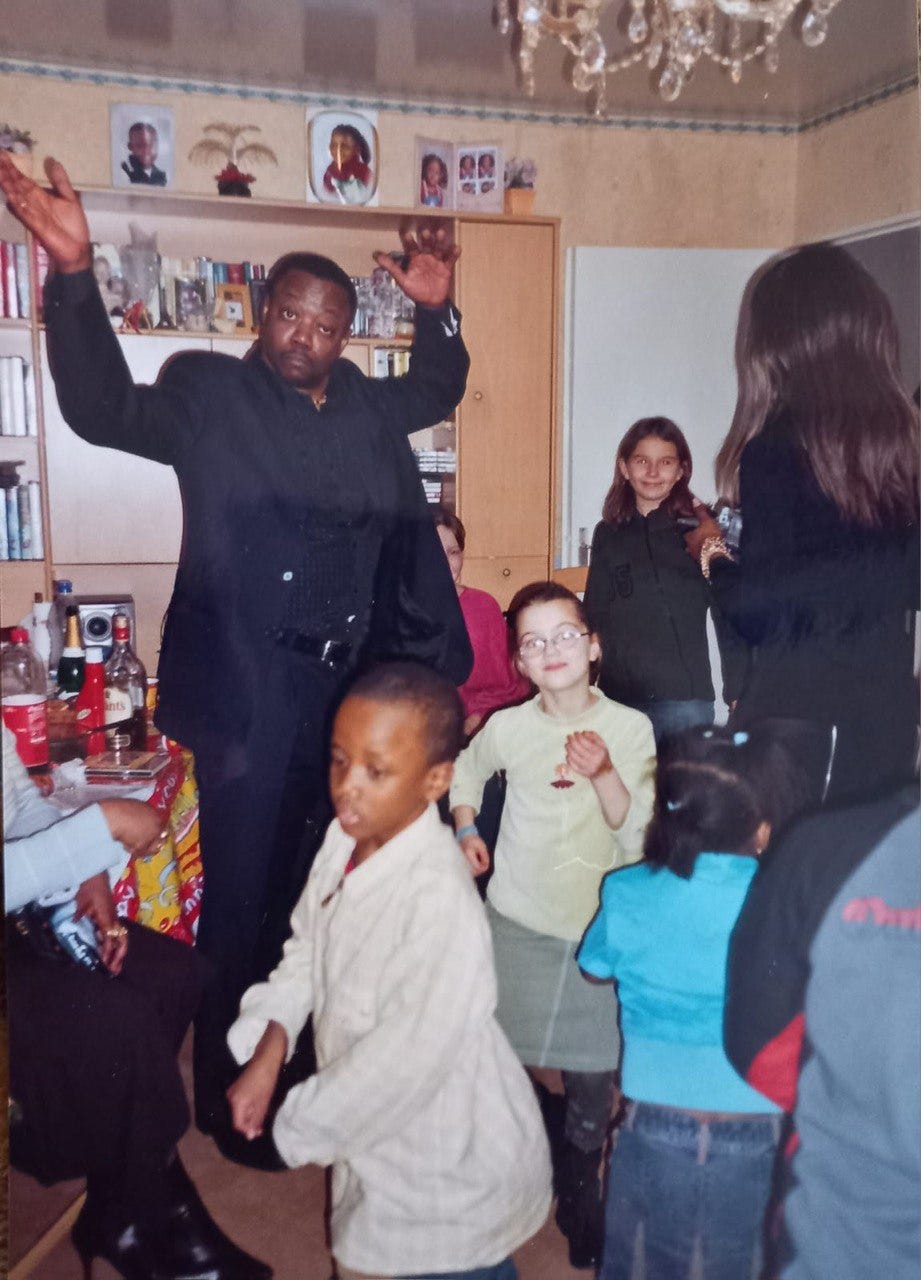
My father died in 2024. The whole world seemed to gather at his deathbed. People flew in from Kinshasa, from Belgium, from the UK—most of them I had never met or even heard of. They all knew me. They spoke my name with familiarity, as if I had always existed inside their stories of him.
My father was not a father. He chose absence—emotionally, physically, financially. He could be a sexist asshole to the women around him. That is true. I love him. That is also true.
In the hospital room, people kept repeating the same sentence: C’était un grand monsieur. He was a great man. A man of stature. A respected man. They said it with reverence, with softness, as if the sentence itself was a prayer.
For months, I couldn’t make sense of that. My body refused to. A great man? Really? A man who couldn’t take care of his own children? I felt anger rise in me like heat. I spent so much energy arguing with cis men about my reality, defending my childhood, insisting on the facts of my experience. I needed them to understand that the public image and the private truth did not match.
But eventually I realized that the arguing was a way to avoid my grief. Because beneath the anger was something far more destabilizing: my father chose to show up for some people, and he did not show up for us. He was capable of presence. He simply did not give it to his children.
That is a particular kind of wound. Not incapacity. Not ignorance. Choice.
When I finally let that land in my body, the fight drained out of me. What remained was something heavier and quieter. The unbearable complexity of it all. He was absent, and he was loved. He failed us, and he mattered to others. He hurt me, and I love him.
There is no clean ending inside that contradiction. No tidy moral. No condoning. No final verdict that makes the story easier to carry. There is only the slow work of integration—the willingness to let all of it exist at once inside the same body.
Maybe this is what living without closure actually demands of us: that we stop trying to collapse people into a single narrative. That we allow love and harm to share the same sentence. That we resist the seduction of simplicity.
My father was not the father I needed. He was, apparently, a great man to many. Both truths live in me now. And learning to hold them without splitting myselves in two has been its own kind of mercy.
Dear one, I wrote all of that to say:
When we don’t get closure, we can’t lock the past away. And perhaps that’s a gift. There is no such thing as locking anything away. Our governments try — building cages, calling it safety — but locking away disappears people, not social conditions. Refusing that logic might be one of the most honest and brave things we can do. So, don’t lock yourselves away. Find the people who want to be free with you.
When we can’t lock the past away,
Politically: we refuse the lie that the past is over.
Somatically: we expand our internal world to live alongside it.
Spiritually: we become humble enough to acknowledge that in our bodies — on the soil that holds us — there is enough room for our ghosts.
And right now, we need room for our ghosts more than ever. We are living inside the consequences of our refusal to grieve — and our obsession with tidy endings.
The past is now. The future is ancient. So are we.
Your beautiful, small human heart is capable of immense contradiction. You are a living contradiction.
If I had received the perfect apology or explanation, I might have felt better. I might have closed the book.
Instead, the pages are still turning.
And because I cannot close the book on my own pain, I find it much harder to close my heart to the pain of others.
PS: Before sending this to you inbox, I always say a little prayer to ask God to show this to one person who really needs it. If this is you, I am so glad.
Sending big care your way,
Stay ungovernable, don’t ever lock yourselves away, I won’t either. Pinky promise?
Care
*Studies I am referring to in this essay:
https://pmc.ncbi.nlm.nih.gov/articles/PMC5442255/
researchgate.net/publication/9016514_The_Need_for_Closure_and_the_Spontaneous_Use_of_Complex_and_Simple_Cognitive_Structures?__cf_chl_tk=yzXZAE1e9GYbRPfpX8Ci_Ocp1LR326mHUL9WUfYDmTY-1770825630-1.0.1.1-aoLJW6VRl2wcV6WTcyVNTmgOicA6x50YCfQBardDEIY
https://www.sciencedirect.com/science/article/pii/S0001691825005530
https://asistdl.onlinelibrary.wiley.com/doi/10.1002/meet.2014.14505101066
enjoy the rabbit hole =)
sitting in visuals of
how closure
can be an x
a snake of a crossroad
leading two or more paths
just to two or more paths
♾️